
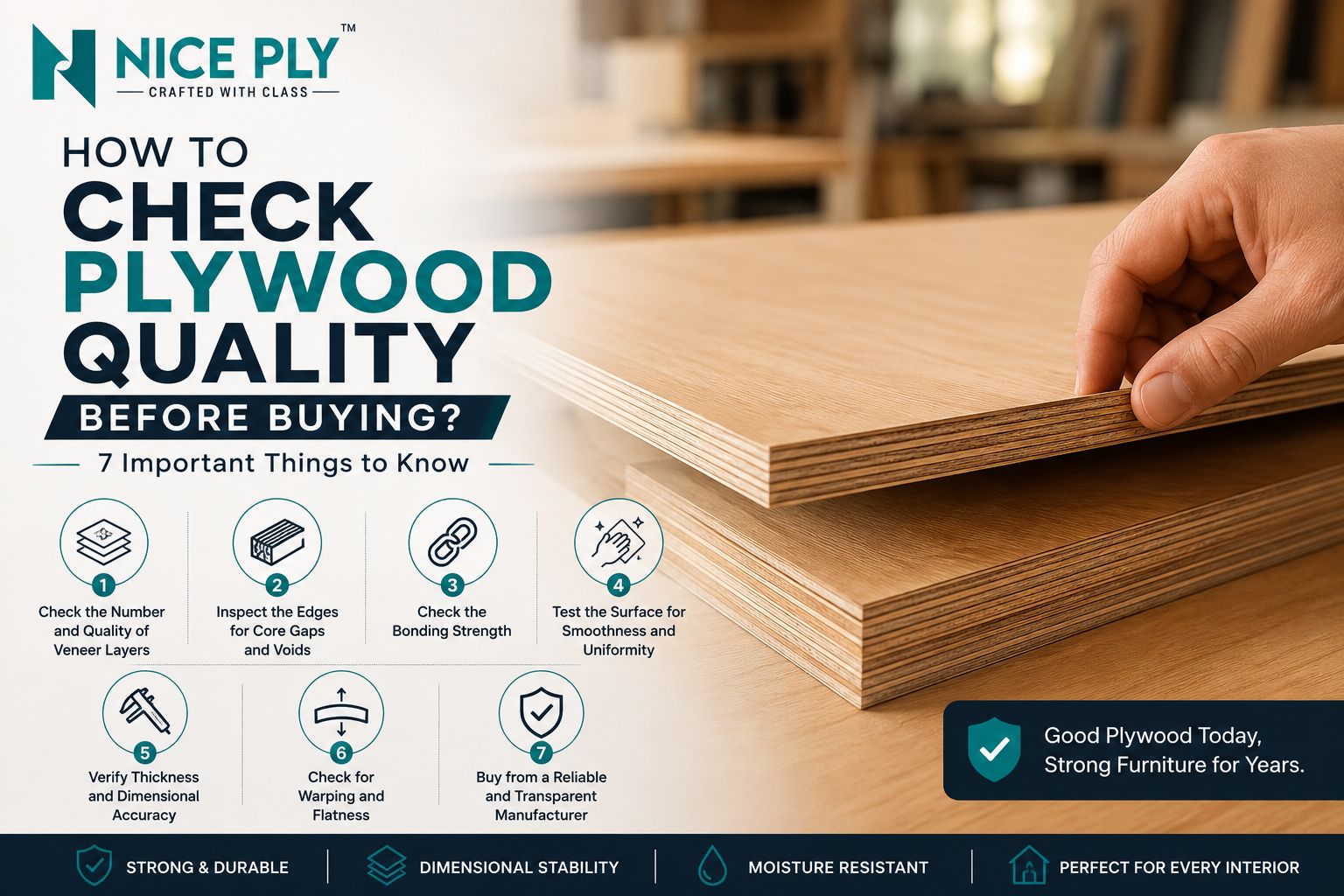
Using plywood solely based on the factors of cost, thickness, or appearance alone may result in expensive mistakes in the future. Furniture-grade, wardrobe-grade, kitchen grade, door grade, partition-grade, and interior plywood must have enough strength, good bond quality, dimensional stability, and moisture resistance depending on their application.
There are many Plywood Manufacturers such as Nice Plywood which provides varying grades of plywood, and buyers need to know how to check the true quality of the sheet prior to purchasing.
7 Important Factors to Check:
1. Check the Number and Quality of Veneer Layers
A good plywood sheet is manufactured by bonding multiple layers of wood veneers under controlled pressure and temperature. The layers should be evenly arranged and properly bonded.
Check whether:
- The core layers are properly packed
- There are no large gaps or overlaps between veneers
- The layers appear uniform across the edges
- The core does not contain excessive voids
More importantly, plywood should have a well-constructed core rather than simply a high number of layers. The quality manufacturing and proper bonding determine the sheet’s actual performance.
2. Inspect the Edges for Core Gaps and Voids
One of the easiest ways to evaluate plywood is by closely inspecting its edges. Large gaps between veneers can weaken the sheet and reduce its screw-holding capacity.
Poor-quality plywood may have:
- Visible holes or empty spaces in the core
- Uneven veneer layers
- Excessive filler material
- Loose or poorly bonded layers
Sheets with a compact, uniform core generally offer better structural strength and machining performance. This is why leading Best Quality Plywood Manufacturers focus on controlled veneer selection and consistent core construction.
3. Check the Bonding Strength:
The bond of the adhesive between veneers is very important in determining how well the plywood performs. The poor quality of bonding may result in separation of veneers due to water or other environmental conditions such as change in temperatures and usage.
It is important to know whether your plywood is right for your intended purpose before you purchase one. Different grades of plywood have different levels of water resistance and can only be used in some environments but not others. For example, for wet places like the kitchen, you need to get the correct plywood grade.
This information should be provided by a reputable plywood manufacturer like Nice Plywood.
4. Test the Surface for Smoothness and Uniformity:
The face of the plywood should be smooth, even, and free from major defects. Run your hand across the surface and inspect it under proper lighting.
Look for:
- Cracks or splits
- Raised patches
- Uneven sanding
- Open knots
- Surface bubbles
- Excessive patches or repairs
A well-finished surface improves the quality of laminating, veneering, painting, and polishing. It also helps achieve a cleaner appearance in the final furniture product.
5. Verify Thickness and Dimensional Accuracy:
Check if the sheet has the specified thickness. Even a slight deviation from the required thickness may have a significant effect on the manufacture of furniture, particularly modular furniture.
Measure thickness at various locations with a gauge and do not rely only on the edge of the sheet. Also inspect whether the sheet is properly aligned and square.
High-quality plywood should maintain reasonable consistency in:
- Thickness
- Length and width
- Surface flatness
- Edge alignment
Dimensional consistency is a major indicator of controlled manufacturing processes followed by professional Best Plywood Manufacturers.
6. Check for Warping and Flatness
Place the plywood sheet on a flat surface and observe whether it sits evenly. A warped or bent sheet can create problems during cutting, installation, and furniture manufacturing.
Check for:
- Bowing along the length
- Twisting at the corners
- Uneven edges
- Surface deformation
Proper moisture control during manufacturing and storage plays an important role in maintaining plywood stability. A flat and stable sheet helps improve fabrication accuracy and reduces material wastage.
7. Buy from a Reliable and Transparent Manufacturer
However, quality control should not end at physical inspection only. Always be sure of the credibility of the manufacturers, product specifications, production process, and quality control process.
A Reliable Plywood Manufacturer gives detailed information about their product grades, dimensions, uses, and performance qualities. This ensures that customers buy plywood depending on their actual needs, and not just on prices alone.
Best Quality Plywood Manufacturers – Nice Plywood:
Inspecting the quality of plywood prior to purchasing needs more than just inspecting its surface. The core, bonding, thickness, flatness, surface finish, and fitness for purpose should all be inspected. Quality plywood from Nice Plywood is what will increase furniture longevity, maintenance problems, and ultimately value for money.
Using products from reputable Best Quality Plywood Manufacturers gives the buyer confidence. We provide quality-focused manufacturing and careful material selection help deliver plywood solutions designed for dependable use across diverse interior and furniture applications.
Frequently Asked Questions (FAQs)
You can check plywood quality by inspecting the veneer layers, core gaps, bonding strength, surface finish, thickness, flatness, and overall dimensional accuracy. Buying from reliable Plywood Manufacturers also helps ensure consistent quality.
The key factors include a strong and uniform core, proper bonding between veneer layers, accurate thickness, smooth surface, resistance to moisture, and good dimensional stability.
Check the edges for visible gaps, holes, uneven veneer layers, excessive filler, or poorly bonded sections. A compact and uniform core generally indicates better-quality plywood.
For kitchens and other areas exposed to moisture, choose plywood with suitable water or moisture resistance according to the application. Best Quality Plywood Manufacturers can help you select the appropriate grade based on your requirements.
Reliable Best Plywood Manufacturers generally provide consistent product quality, accurate specifications, proper grading, and better quality control. This helps buyers choose plywood that offers durability and long-term value.